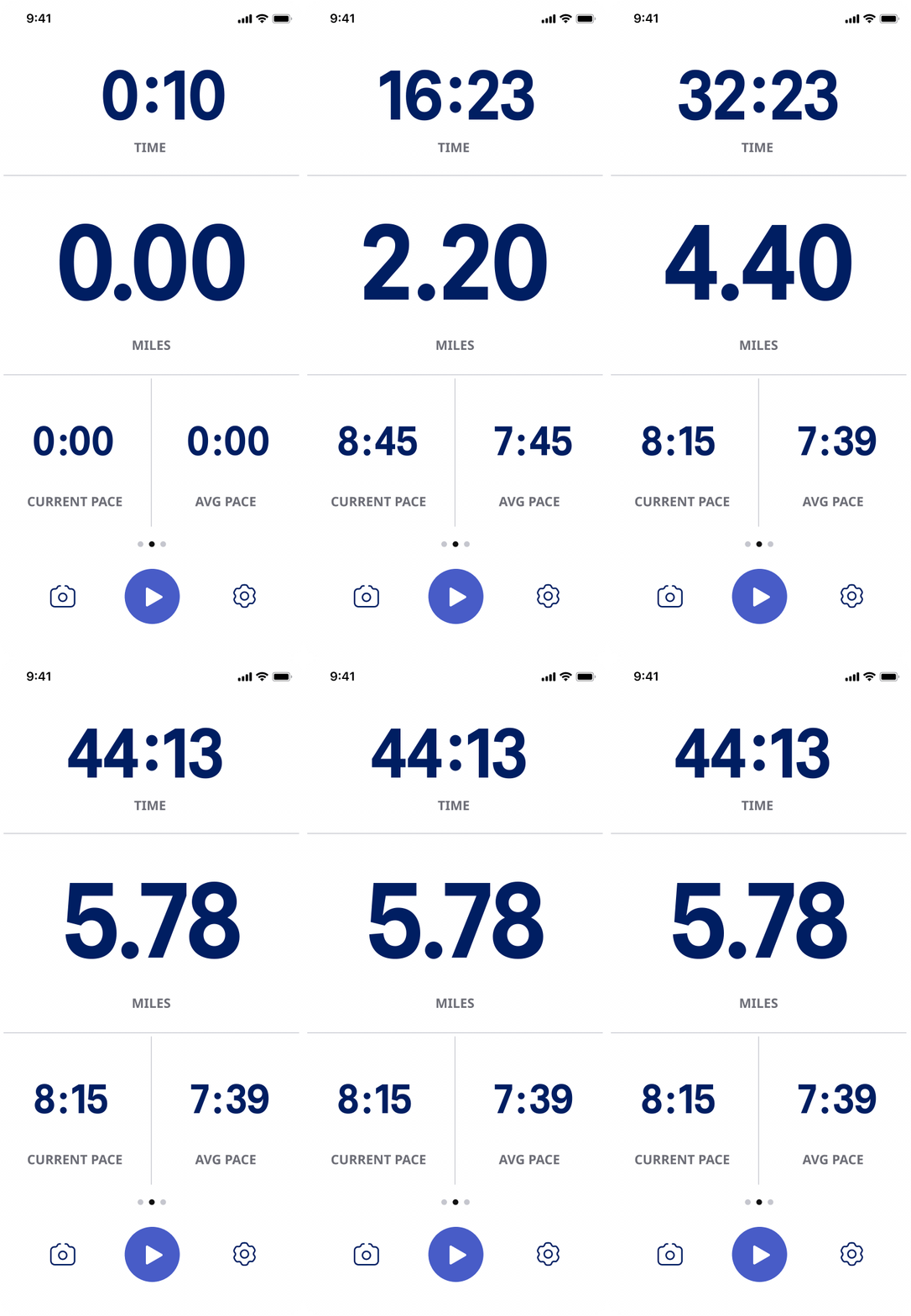



• What is RunKeeper? RunKeeper is the personal trainer for your pocket. Track your running, walking or biking activities with our mobile app (iPhone and Android), or log in to the website to get further insight into how you're doing against yourself or your friends.
  • How to make running buddies work for you

    By Billy Lazzaro

    What’s the sound of one man running? Sounds an awful lot like sleeping. If you’re anything like me, the hardest part about running before work is getting out of bed.  I kind of hate running. Or maybe it’s that I really enjoy team sports, and an early morning run will never be as fun as playing a game of soccer. There aren’t even points! Come on!  So, how do I motivate myself to get out there and run? I let someone else do it! 

    I’ve had a few different sets of run buddies throughout my life, with different levels of success. Here are some of the things I’ve learned:

    Getting a running buddy

    Sometimes this is the hardest part. The easiest way to find someone to run with is to ask a runner to run with you. That sounds stupid, but seriously just ask someone! You might be afraid because you’re worried that you might not be fast enough, or you are worried about being rejected. Don’t be worried! For many people, the hardest part of running frequently is getting your butt out there, and your runner friend will likely be as glad as you are to have the motivation. Sometimes you can get a group together easily, which is even better!

    What to do with your running buddy

    Set a schedule and stick to it! Decide how far you want to go and get a basic route together before you arrive. I’ve had the best success running at the conversational pace of the slowest runner.  As you continue to run together this pace will gradually quicken.

    There are going to be days when you are lying in bed thinking of a great excuse to text your way out of running: don’t do this. Just go. As soon as you start running you’ll be glad you did.

    Still worried you’re too slow? Try meeting up at a local track or someplace with a short loop. Make sure your buddy knows that if they want to speed up, you’ll meet them when you are both finished for high fives!

    Who are your running buddies are and how do they push you along?

     Billy is a software engineer at RunKeeper and can be found running the streets of Somerville,  as long as his run buddy holds him to it!

  • We’re all about goals with RunKeeper 3.4 for iPhone!

    We thinking having a target to work towards greatly improves your chances of sticking to a fitness routine, which is why we introduced goals in the app last year. We’ve taken in your feedback since launching this feature, and are pleased to announce some major enhancements that we think will make it easier for you to achieve big things using RunKeeper!

    • Maybe you like to take it one week at a time when it comes to your goals, rather than thinking about things in the long run. We’ve updated our goals feature to allow you to focus on frequency—say, working out three times a week.
    • And you might not know just how long it will take you to rack up 100 miles, or you’ve hit that goal, but just a few days after you said you wanted to.  You can now enter a big goal like this without a particular end date!
    • If you realize the goal you entered isn’t quite right for you, you can easily delete it and start over, straight from the app (just hover over the goal and swipe your finger to the left).

    We want your goal to be front of mind whenever you exercise, so now you’ll see just how you’re progressing against this target after each workout. You’ll also see cool new details about the workout, like your notes, splits, elevation charts, and photos, all in one convenient screen. This window into your progress should make hitting your goals that much easier!

    imageimageimage

    That’s it, you’re out of excuses for not setting a goal! Download the 3.4 iPhone update and let’s get this target in writing, OK? 

  • Looking to step up your weight loss? Put your money where your mouth is!

    By Jamie Rosen, DietBet

    There’s a big connection between running and weight loss. Running burns roughly 100 calories a mile. More importantly, it boosts your energy all day and makes you more conscientious about your health and diet. Plus, time spent running is time not spent popping Skittles on the couch. (And losing a few excess pounds before a big race can help boost your times, too.) 

    No doubt that many of you already know this, and this is why you’ve looked to RunKeeper to set weight loss goals. For those of you in that camp, what keeps you on track? Is it a solid workout schedule? Calorie counter? Avoiding the cookie aisle?

    Now imagine if there was money on the line. If you didn’t lose those pounds you said you would, then you’d have to pay up, and if you did, you stood to earn a nice reward!  Oh, and you’d have your friends cheering (or heckling) you on along the way. 

    That’s where DietBet comes in! DietBet uses basic behavioral economics­—financial incentives and loss aversion—to give you extra motivation to get in shape (you RunKeeper users who connect to GymPact are likely familiar with this concept). Players bet money into the pot and commit to lose 4% of their starting weight in 4 weeks (we’ll be offering other options soon). Once you’ve bet money on yourself, the psychology of weight loss changes. It’s suddenly easier to pass on dessert or to drag yourself out of bed on a cold, wet Saturday morning to get in a run. Think of what you already do for money, like putting up with your boss, and imagine how much easier it’ll be to exercise and eat right if you’re getting paid to do it. That’s the power of DietBet.

    image


    But DietBet isn’t only about money. Like RunKeeper, it’s also about fun social interactions. You can easily set up a bet with other friends and take those weight loss goals from personal to communal. When you play in a DietBet, you get to compete, trash-talk, and collaborate with all the other people in your game. Since DietBet is not winner-take-all (everyone who hits the goal splits the pot evenly), there’s a spirit of camaraderie and support that arises from working towards a shared goal, a collective sense of accomplishment that will be familiar to all RunKeeper users. 

    RunKeeper and DietBet are kindred spirits. At their core, they’re all about healthy motivation. Both have an almost magical ability to transform what many people would consider dreary and solitary chores—running and losing weight—into fun, uplifting social activities. You can connect your RunKeeper account to Dietbet here

    So if you want some extra help in your mission to losing weight, check out DietBet. It’s a snap to set up a game and invite friends, or you can just join a game starting soon at DietBet.com. You decide how much to bet and when to start. And now, you can record your weight on RunKeeper (or by connecting a Withings scale to your account) and we’ll post it on DietBet

    Jamie Rosen is Founder & CEO of DietBetter, makers of the DietBet Social Dieting Game

    What do you think? Have you found friends (or money) to be motivational? How would you use DietBet?

  • The crew at Jawbone was so excited about our integration, they decided to run a route with RunKeeper that spelled out Jawbone. Pretty awesome, right?

    The crew at Jawbone was so excited about our integration, they decided to run a route with RunKeeper that spelled out Jawbone. Pretty awesome, right?

  • I’ve caught the running bug

    I’ve got a pretty bad case of the runs.

    There’s something that happens to me when I’m revving up to try running again. Other on-again, off-again runners (and I use the term runner loosely) can probably relate. I start dreaming about running. And in my dreams, I’m running smoothly and painlessly and I feel immense joy. My nighttime dreams become daydreams. Then I start talking about it out loud.

    “I’m thinking of giving running another try,” I say and get a surge of happiness. My friends roll their eyes, “Oh my God, the running again.”

    Eventually, inspiration meets courage. I lace up those sneakers and head out. Then Newton’s Laws of Motion smack me in the face with a harsh dose of reality. Because man, it’s hard to get this body moving.

    I’m a non-runner runner. What I mean is, I feel like deep down I’m a runner, but I don’t actually run. It’s like a club I’ve hoped to join my entire adulthood. I’ve attended a few meetings and I really like the other members. I feel like I could maybe belong.

    I never had the privilege of being naturally athletic. I was shy and self-conscious as a child and I have always struggled with body image.  I tried softball once in middle school (turns out, it’s tough to have a softball career when you’re afraid of the ball.) I’m also hopelessly uncoordinated. But there was a period, eight glorious months sometime in my twenties, when I did run. It was the first time I ever felt physically capable and proud of my abilities. And then? I don’t know. It just dwindled. I’ve got a bunch of good excuses, but I’ll spare you. 

    Still, I guess if there’s one thing I can say about me, it’s that I keep trying. And this time feels different.

    Now that I’m in my thirties (early thirties), I’m starting to realize that time keeps steamrolling ahead. I keep asking myself lately, “If not now, when?” And I don’t have a satisfactory answer. That gets me moving. I’m also elated to discover that heading out for 30 precious minutes in the morning gets me away from my kids. I adore my children, aged three and four. But I have little patience for their “I want-I need-I don’t like that” morning chorus. I get to step out into a world of tweeting birds and 90s pop hits, leaving that chaos behind for my husband to sort out. It’s delightful even when running isn’t.

    I’ve got some forces working against me; my pace is so slow I have to sprint to pass a walking elderly man. Before each run I feel fear, dread, and resistance. It’s uncomfortable to move this body of mine. But I don’t care.

    Because the only cure for a bad case of the runs—is to run.

    Meaghan O’Keeffe is a freelance writer. You can see her running/walking in Framingham, MA. If you blink, it’s ok because you won’t miss her. In fact, if you blink three times, you still won’t miss her.

  • A universal calendar that could make everything better

    By Sandeep Hazarika

    Last week my colleague Karla talked about her tips for making time for exercise despite crazy family and work schedules.

    I also face the same struggle as a parent: scheduling your life around kids’ homework, no school days, after school events, swimming lessons, and other activities is a huge challenge and it consumes you.  And on top of that, you also need to have a career.  So, how do I make time for exercise?

    I think the right piece of technology could help fix this. Let me backtrack.

    Growing up in a tropical climate, I spent my entire childhood being outside playing cricket, soccer, etc.  My parents didn’t own a car and I used to walk or use public transportation to go anywhere. No need for joining a gym or really scheduling exercise.  I moved to the US to attend graduate school and while in school, I still had the same active lifestyle as I’d when I was growing up.  This changed soon after I started working, as evidenced by the report of high cholesterol I received at a doctor’s appointment. I promptly joined an indoor soccer league through work to fix this. But now that I am a parent, having kids means you are bound to their schedules, and joining that work soccer league is no longer a possibility. 

    I also happen to live in New England, where you are lucky if you get six months of ‘warm’ weather.  I either have to plan workouts around when it’s nice outside, or rely on a treadmill (but that’s not very motivating, especially when it’s tucked away in a musty basement.) 

    We can’t control the weather, but we can certainly plan around it.  How?  Could a service like RunKeeper help someone like me?  I think it definitely could. 

    Here is an interesting use case I personally encountered a couple of months ago:  I’d promised my youngest child that we would go to see Wreck-it Ralph on a particular Saturday afternoon this past February.  As we were driving towards the movie theatre, I realized that that it was an unusually nice day, so I asked my child if we could go on a bike ride instead and go to the movies later. The response I got back was: “But Daddy, you promised me that we are going to the movies now!” Yes, that was a fact and there was going to be no discussions around that - so we went to the movies instead.  By the time we got back, it was no longer nice and we ended up spending the rest of the afternoon and evening inside.  

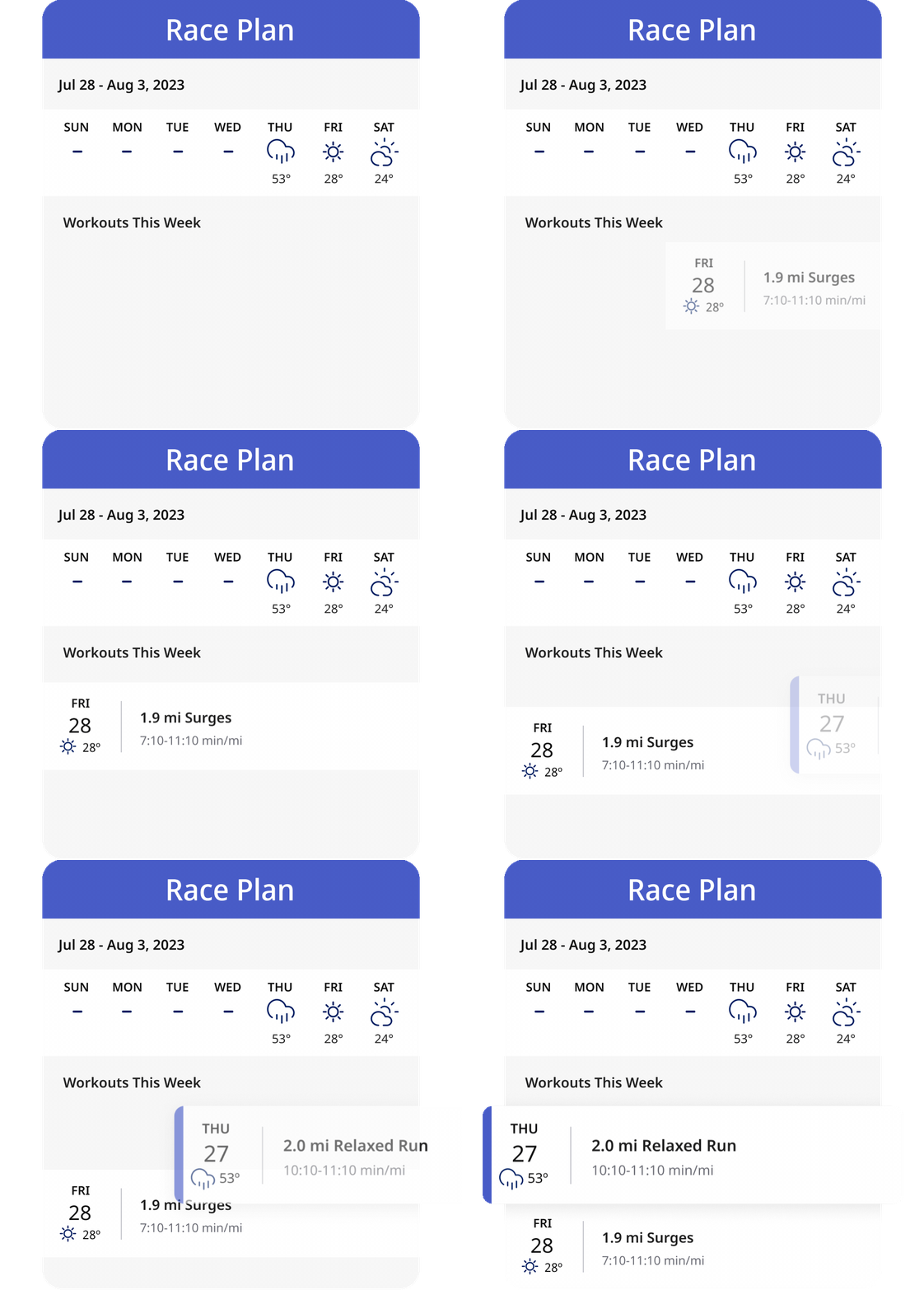
    Now consider this scenario:  RunKeeper provides me with a universal calendar where I store all of my activities and commitments in one place, without me having to juggle between multiple calendars.  And it just so happens that RunKeeper is also integrated with a weather app that provides timely in-app notifications about the weather.  Two days before that Saturday I was supposed to go to the movies with my youngest child, I could instead get an in-app notification from RunKeeper informing me that the weather is supposed to be nice (hallelujah!) and I should make plans to be active outside.  So, I start to negotiate with my child about switching the time for the movie and adding in a bike ride also.  Since I’m doing this in advance and not at the last minute, my probability of success goes up and we end up agreeing to going for a bike ride in the afternoon and then go to the movies in the evening.  Isn’t that just wonderful?

    image

    The product team at RunKeeper is always working hard to build great features, but this is the one I’m dreaming for. In the meantime, I have to step up my negotiation skills—not just with my child, but also with the RunKeeper product team!

    What about you? What would help you get out there more? How do you plan workouts with family and busy schedules? 

     Sandeep is the chief data cruncher at RunKeeper and father of two school age kids

  • Consider this your first quarter progress report on how you all are doing this year with RunKeeper. Your grade? F—for freaking awesome! 
Together you’ve spent the equivalent of 177 decades working out from January to March (can you even wrap your head around that?) Those 8.4 billion calories burned stack up to about 58 million scoops of ice cream, and you completed some 3.1 million marathons between all those miles you ran, walked, biked, hiked, cross country skied (we’re talking to you, Sweden), and more. 
Speaking of Sweden, let’s congratulate them for their strong showing: two of the top five most popular cities on RunKeeper, and the No. 2 most popular country (again) in the first three months of this year! And big thanks to the Big Apple for getting a U.S. city to the top! 
Keep it up! At this rate you’re well on track to smash 2012’s numbers. 

    Consider this your first quarter progress report on how you all are doing this year with RunKeeper. Your grade? F—for freaking awesome

    Together you’ve spent the equivalent of 177 decades working out from January to March (can you even wrap your head around that?) Those 8.4 billion calories burned stack up to about 58 million scoops of ice cream, and you completed some 3.1 million marathons between all those miles you ran, walked, biked, hiked, cross country skied (we’re talking to you, Sweden), and more. 

    Speaking of Sweden, let’s congratulate them for their strong showing: two of the top five most popular cities on RunKeeper, and the No. 2 most popular country (again) in the first three months of this year! And big thanks to the Big Apple for getting a U.S. city to the top! 

    Keep it up! At this rate you’re well on track to smash 2012’s numbers

  • What’s in your blood?

    We’re talking nutrition again today with the folks at InsideTracker. Read below for some common nutrient imbalances they see, and how you can find out how nourished you really are. 

    By Perrin Braun, InsideTracker

    If you could look under the hood to what’s going on inside of your body, you might be surprised by what you find. Many people—even elite professional and Olympic athletes—who seem “healthy” may actually have some biochemical issues that affect their performance.

    We see this a lot at Inside Tracker.  We use a simple blood test to measure up to 20 blood biomarkers that can serve as a guide to your well being and athletic performance.

    We’ve seen lots of blood, and in the process have come across some biomarkers that are out of range among a lot of our clients. We’ve listed them below, and included some information on what they mean for your health and performance, as well as how to restore the imbalances

    Common imbalances

    Vitamin D  and Calcium – Low levels of each of these can increase the risk of low bone mineral density and stress fractures. Vitamin D is essential for bone health because your body needs it to absorb calcium. It also regulates the development and maintenance of the nervous system and of skeletal muscle. Calcium plays an integral role in the growth, maintenance, and repair of bone tissue, maintenance of blood calcium levels, regulation of muscle contraction, nerve conduction, and normal blood clotting. Dairy products like milk, yogurt, and cheese are famous for being good sources of calcium, but you can also eat more leafy green vegetables (think kelp and spinach), dried beans, and legumes to improve your levels!  To improve your vitamin D levels, eat more fatty fish (such as sardines, mackerel, and salmon), egg yolks, butter, beef liver, cheese, and fish oil. Some foods, such as milk, yogurt, cereal, and orange juice, are now fortified with vitamin D, so be sure to check the label of your favorite foods to see if they contain vitamin D! 

    Hemoglobin and Ferritin–Hemoglobin is a protein that is partially composed of iron and found mainly in red blood cells. Ferritin is a protein that stores iron, and therefore it is a good marker for the amount of iron in the body. Hemoglobin transfers oxygen to the muscles, brain and other organs, and helps the body to convert carbohydrates and fat into forms of energy. If you don’t have enough hemoglobin, your muscles will not get optimal amounts of oxygen and your body won’t use energy as efficiently when you run. Why might you be low in iron? During intense workouts, you lose iron through sweat, and runners also lose iron through gastrointestinal bleeding. Pre-menopausal female athletes are at an especially increased risk for low iron and hemoglobin levels because of blood losses during menstruation.  And many people simply don’t eat enough iron-rich foods, such as red meat, rice, wheat, oats, nuts, dark leafy greens, and beans.

    Vitamin B12 – A quarter of InsideTracker customers found they had too much vitamin B12 in their blood. The body uses vitamin B12 to create new blood cells and to maintain its nervous system, but too much can cause symptoms like rashes, headache, nausea, and chest discomfort. You can find plenty of vitamin B12 in animal products such as meat, eggs, cheese, shellfish, and also in some fortified breakfast cereals, so if you’re eating these foods, you probably have enough. It’s likely that InsideTracker customers and many athletes had high B12 from taking unnecessary multivitamins and vitamin B12 supplements, or consuming energy drinks that are extremely rich in vitamin B12.

    Creatine kinase–Creatine kinase (CK) is an enzyme found primarily in muscle tissue. It is located only inside healthy muscle cells, and any presence in the blood means that muscle cells have been damaged and some or all of the content has leaked into the blood. Athletes who exercise when their levels of CK are very high are at risk of cramping during exercise and even serious injury. To repair muscle damage, your body needs protein, which is made up of amino acids, the building blocks for your muscles. You can find lean sources of protein in soy, chicken, beans, and legumes.

    How can you get started with InsideTracker?

    Of course, everyone’s blood is different. You may be experiencing some of these oddities yourself, but the best way to know is to get analyzed and tested. InsideTracker  uses what’s called an “optimal zone” in the blood analysis—a number that is specific to each person, taking into account his or her own unique demographic information such as age, gender, ethnicity, activity level, as well as lifestyle and performance goals. We determined the optimal zones for each marker based on the latest peer-reviewed scientific research. 

    Once you’ve gotten your exact results, we help recommend a path toward improving them, through diet (we have a database of 7500 food items you can find in your local grocery store), supplements, or tweaks in exercise and training.

    If you’re a RunKeeper user who’s living in the U.S., you can purchase an InsideTracker plan that includes a blood test, or you can take advantage of the “do it yourself” (DIY) plan, which allows you to enter your most recent blood tests results from your primary care physician. By improving your biomarkers, you can help to boost your endurance and speed! Who doesn’t want that?

    Perrin is a nutrition and public health graduate student at Tufts University. In her spare time, she enjoys running, hot yoga, and thinking about her next meal.

  • Extreme Makeover, RunKeeper.com Edition

    Guess what? We’re launching a fresh new redesign of RunKeeper.com! Yes you’re reading that right. And feel free to do a happy dance

    We created RunKeeper to be a powerful personal trainer in your pocket, but many of you look to our website to do things like drill deeper in your workout tracking, interact with friends, and connect with other partner apps. That hasn’t exactly been looking its finest for some time now, and many of you have been sure to let us know how you feel about that.

    Rightfully so. There were buttons for things like routes, races, training, plans, and apps–twice, in two different places. What does that even mean? Meanwhile, cool functions like finding friends and connecting your RunKeeper account to other apps were pretty buried.

    Before

    image

    And if you were just getting started on RunKeeper, many of these pages, were, um, depressing.

    image

    image

    image

    Not anymore! We’ve taken the time to give RunKeeper.com the revamping it was due (especially considering the spiffy new redesigns our mobile apps got earlier this year). Now the website offers the same inviting, fun, and helpful experience that RunKeeper for iPhone and Android do (we hope!).

    After

    image

    image

    We’ve cleaned up the navigation on top, so the features you interact with the most are clear and easily accessible: the ‘Feed’ button will show you what your friends are up to; ‘Me’ takes you to your activity history, fitness reports, training plans, routes, and more. Click the ‘Log’ button to easily post a new workout.

    For those who are new to RunKeeper, these different pages offer helpful, friendly guidance for getting up and running (pun intended) with us.

    image

    image

    image

    We’re not claiming this new site is a masterpiece, but it is a significant improvement over what was there before and lays the foundation for us to make it more awesome in the months to come–so stay tuned for a bunch of exciting stuff in the near future!

    To accomplish some of our goals, we had to move a couple things around with this update. To help existing users adjust, we’ve set up a guide to help highlight some of the more significant changes below.

    image

    We hope you see RunKeeper.com as a helpful and fun tool for tracking your fitness journey (you friends’ too!)! Let us know what you think!

  • Proud to say that I finished the race

    In the four weeks since the Boston Marathon, we’ve come across many stories of our users who were there or deeply affected by the tragedies. We will continue to post these in the hopes of bringing others encouragement and healing. Please e-mail us if you would like to share yours.

    By Kate Plourd

    I stepped out for a run late a few Sunday mornings ago, not knowing where I was headed or where my feet would take me, just ecstatic that I am able to partake in my simple hobby. The southwest corridor bike path took me to the Back Bay and after a loop around Boston Common to the corner of Berkeley and Boylston streets.  It was that same intersection where four weeks ago in a medical tent at the Boston Marathon I learned that a pair of bombs had gone off less than 20 minutes after I crossed the finish line, killing three innocent spectators, injuring nearly 200 others and bruising the spirit of so many more.

    In the past weeks, I’ve considered a lot of thoughts and ideas I could write about in regards to the attacks at the marathon. But as I continue to deal with my own emotions after being so close to this act of terror, the most relevant is that the skills and mindset of marathon running is what Bostonians need to heal from this tragedy.

    It’s going to be hard and it’s going to take a long time, but the Boston community will finish this race and it will finish strong. As President Obama said in his speech-addressing all breeds of Bostonians, from the born and bred to the transplants like myself and the millions who have cycled through this shining city on a hill, we must push on and persevere. The marathon teaches us that. It teaches us, ”To not grow weary. To not get faint. Even when it hurts. Even when our heart aches.” I can’t find better words than the President’s to describe how Boston and the running community will heal from this tragedy. In fact, you can see the healing already beginning through the outpouring of support from all corners of our country and even the world.

    While the heroic acts and flood of the support from complete strangers in the aftermath of the bombings is inspiring, as a marathon runner who has completed both the Boston Marathon and four other marathons, it’s in no way surprising. Boston is unique. Its unnavigable streets and the often-harsh demeanor of its residents may give off an unwelcoming impression. Marathon Monday is a different story. It’s when Boston welcomes people throughout the world with open arms.

    The most disturbing part of the bombing story is that they targeted spectators. Innocent spectators whose only goal that day was to support others in their marathon quest. Not all runners like running races where spectators line the street. As a runner who does, as a runner who thrives off the energy from people who stand around for hours to tell complete strangers that they will succeed and can push through the pain, to show off a funny sign and to hand out oranges or ice, this attack feels even more cowardly. Spectators don’t cross a finish line of glory after a race, they don’t get a medal or a fancy race t-shirt or jacket. They don’t get their name printed in the paper or any of the accolades that come with completing a marathon. They are what help so many of us runners do what we crazily do.

    They say running is a solitary sport, but running a marathon is anything but. And Boston Marathon spectators are truly one-of-a-kind. I would not have made it through last year’s 90-degree Boston Marathon if it weren’t for the spectators handing out ice, spraying hoses and cheering me to Copley Square. I wouldn’t have ran my second fastest marathon last month if it weren’t for that girl who cheered me through a rough moment in Washington Square when I thought I was going to be sick, or the thought that my friends and boyfriend were waiting at mile 25 to give me that one last push to finish strong, or the throngs of spectators (including a few close friends who were thankfully not injured) lining Boylston Streets to support us as we crossed the finish line.

    image

    Many runners–including myself–struggled with how to feel about their accomplishment of finishing or even running the miles they did on Marathon Monday. But if we give up that pride of accomplishment, we are not just letting terrorism win, but we are letting down my favorite part of marathons–and what helps me make it through 26.2 miles–the spectators. Instead, runners should share their stories and help those affected and those struggling with how to cope with the tragedy that they have the strength to make it through this ordeal. Because, as President Obama reminded us, this community is strong and when we feel like it’s just too hard “around the bend a stranger has a cup of water. Around the bend, somebody is there to boost our spirits. On that toughest mile, just when we think that we’ve hit a wall, someone will be there to cheer us on and pick us up if we fall.”

    Proud to say that I finished the race.

    image

    This one is actually a still from a video, but it really shows how happy I am to have finished

    Kate is a public relations professional for Solomon McCown & Co. in Boston and an avid marathon runner with six marathons under her belt. Her post originally appeared here.